
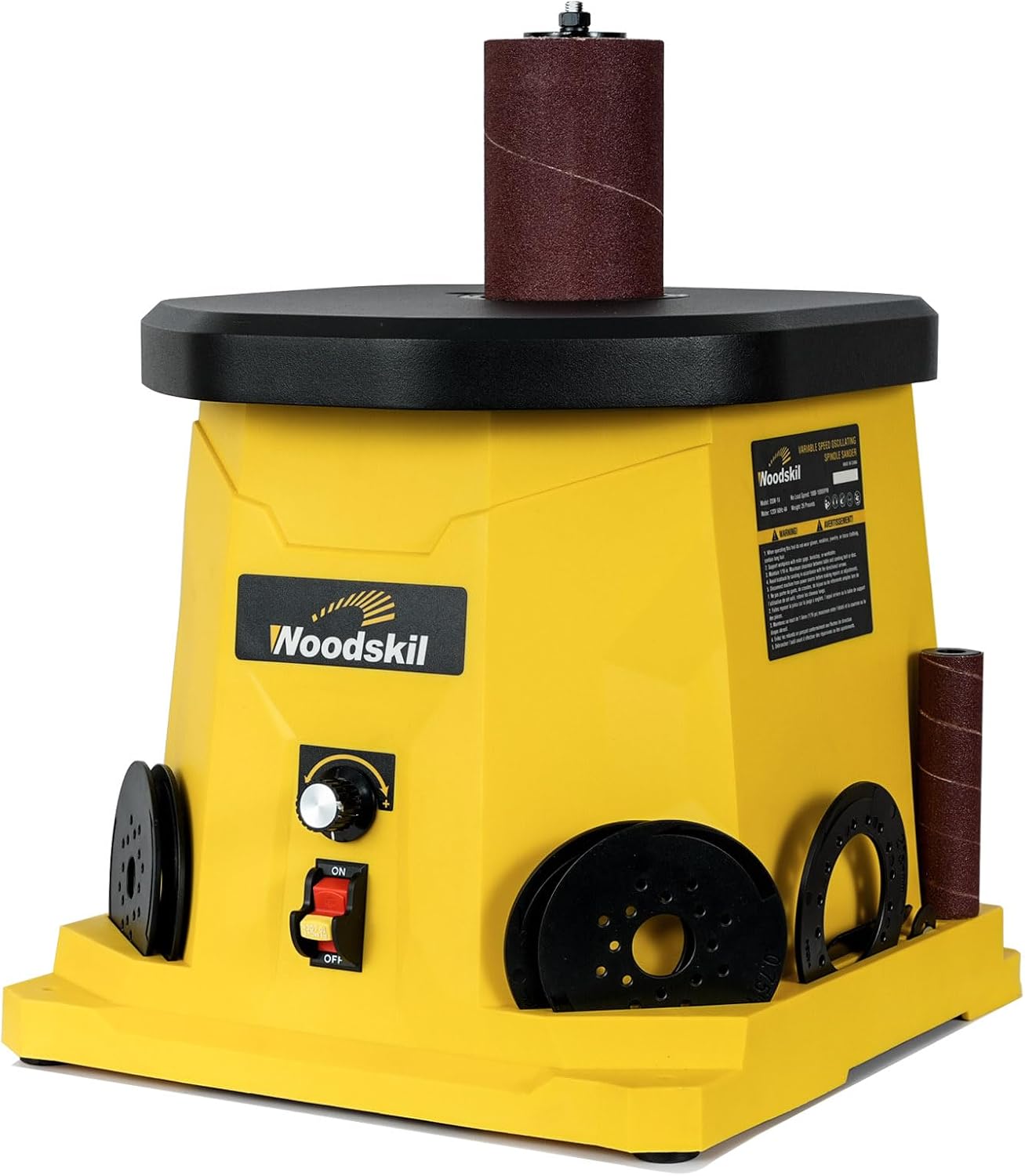

Woodworkers know that sanding curved edges and intricate profiles with a random orbital sander is often slow and inconsistent. Whether you're building furniture, crafting cutting boards, making toys, or creating decorative projects, an oscillating spindle sander can dramatically improve both efficiency and finish quality.
The Woodskil Variable Speed Oscillating Spindle Sander is designed for hobbyists, DIY enthusiasts, and small workshops looking for professional-level curve sanding without the price of industrial machines. Its variable-speed motor, oscillating spindle action, and multiple sanding sleeves make it a versatile addition to any woodworking shop.
Why Use an Oscillating Spindle Sander?
Unlike a standard drum sander, an oscillating spindle sander combines rotational movement with vertical oscillation. This up-and-down motion distributes wear across the sanding sleeve, reduces heat buildup, minimizes burn marks, and produces a smoother finish. It is especially effective for:
- Sanding inside curves
- Smoothing outside contours
- Cleaning up bandsaw cuts
- Refining routed templates
- Preparing projects for finishing
Compared to handheld sanders, a spindle sander offers greater precision and better control when working on curved workpieces.
Key Features of the Woodskil Variable Speed Oscillating Spindle Sander
Variable Speed Control
One of the biggest advantages of this Woodskil model is its variable-speed adjustment.
Different materials require different sanding speeds:
- Higher speeds remove material faster from hardwoods.
- Lower speeds offer greater control on softwoods and delicate workpieces.
- Adjustable speed also helps reduce burning on heat-sensitive materials.
This flexibility makes the machine suitable for everything from aggressive shaping to fine finishing.
Oscillating Sanding Action
The spindle continuously rotates while moving vertically.
Benefits include:
- More even sanding
- Longer sanding sleeve life
- Reduced clogging
- Less heat generation
- Cleaner surface finish
Many experienced woodworkers consider oscillation one of the biggest improvements over non-oscillating spindle sanders.
Multiple Sanding Sleeve Sizes
The machine includes multiple sanding drums and sleeves to accommodate different radii.
This allows users to sand:
- Tight inside corners
- Large sweeping curves
- Decorative profiles
- Furniture components
- Templates
Having several spindle sizes means one machine can handle a wide variety of woodworking projects without additional accessories.
Efficient Dust Collection
Wood dust quickly accumulates during sanding.
The integrated dust port connects easily to most shop vacuums, helping:
- Keep the work surface clean
- Improve visibility
- Reduce airborne dust
- Extend sanding sleeve performance
Proper dust extraction also improves workshop safety and cleanup.
Compact Benchtop Design
Unlike large floor-standing spindle sanders, the Woodskil model fits comfortably on most workbenches.
Its compact footprint makes it ideal for:
- Home workshops
- Garage shops
- Small woodworking studios
- DIY workspaces
Despite its size, it offers the stability needed for accurate sanding.
Common Applications
The Woodskil Variable Speed Oscillating Spindle Sander is well suited for:
Furniture Making
Smooth chair legs, table aprons, curved stretchers, and decorative profiles with excellent consistency.
Cutting Boards
Refine finger grips, handles, and rounded corners before final finishing.
Scroll Saw Projects
Remove saw marks quickly while preserving delicate curves.
Bandsaw Work
Clean up rough cuts without changing the original shape.
Template Routing
Produce perfectly smooth edges after flush trimming.
Toys and Crafts
Finish small wooden projects with improved control and accuracy.
Advantages Over Hand Sanding
Using this spindle sander provides several practical benefits:
| Hand Sanding | Woodskil Oscillating Spindle Sander |
|---|---|
| Slow material removal | Fast, consistent sanding |
| Difficult to maintain curves | Maintains accurate contours |
| Uneven finish | Uniform surface quality |
| High operator fatigue | Minimal effort required |
| Frequent sandpaper replacement | Longer sleeve life through oscillation |
Who Is This Sander For?
This machine is an excellent choice for:
- Beginner woodworkers upgrading from handheld sanders
- DIY enthusiasts building furniture
- Hobbyists working with curved designs
- Small professional workshops
- Makers using scroll saws or bandsaws regularly
If most of your projects involve straight edges only, a belt or disc sander may be enough. But if you frequently work with curves, templates, or intricate profiles, an oscillating spindle sander can become one of the most valuable machines in your shop.
Tips for Better Results
To get the best performance:
- Choose the spindle diameter closest to your workpiece radius.
- Sand against the direction of spindle rotation.
- Apply light, even pressure instead of forcing the workpiece.
- Connect a shop vacuum for better dust extraction.
- Replace worn sanding sleeves to maintain consistent results.
Final Thoughts
The Woodskil Variable Speed Oscillating Spindle Sander combines several features woodworkers look for in a benchtop spindle sander: variable speed control, oscillating action, multiple sanding sleeve sizes, compact design, and effective dust collection.
For anyone regularly sanding curved edges, cleaning up bandsaw cuts, or refining routed templates, this machine offers a significant improvement over handheld sanding. Its versatility makes it suitable for both beginners building their first workshop and experienced woodworkers seeking greater precision and efficiency.
If your projects frequently involve curved shapes or detailed profiles, adding a variable-speed oscillating spindle sander like this can save time while producing cleaner, more consistent results.