
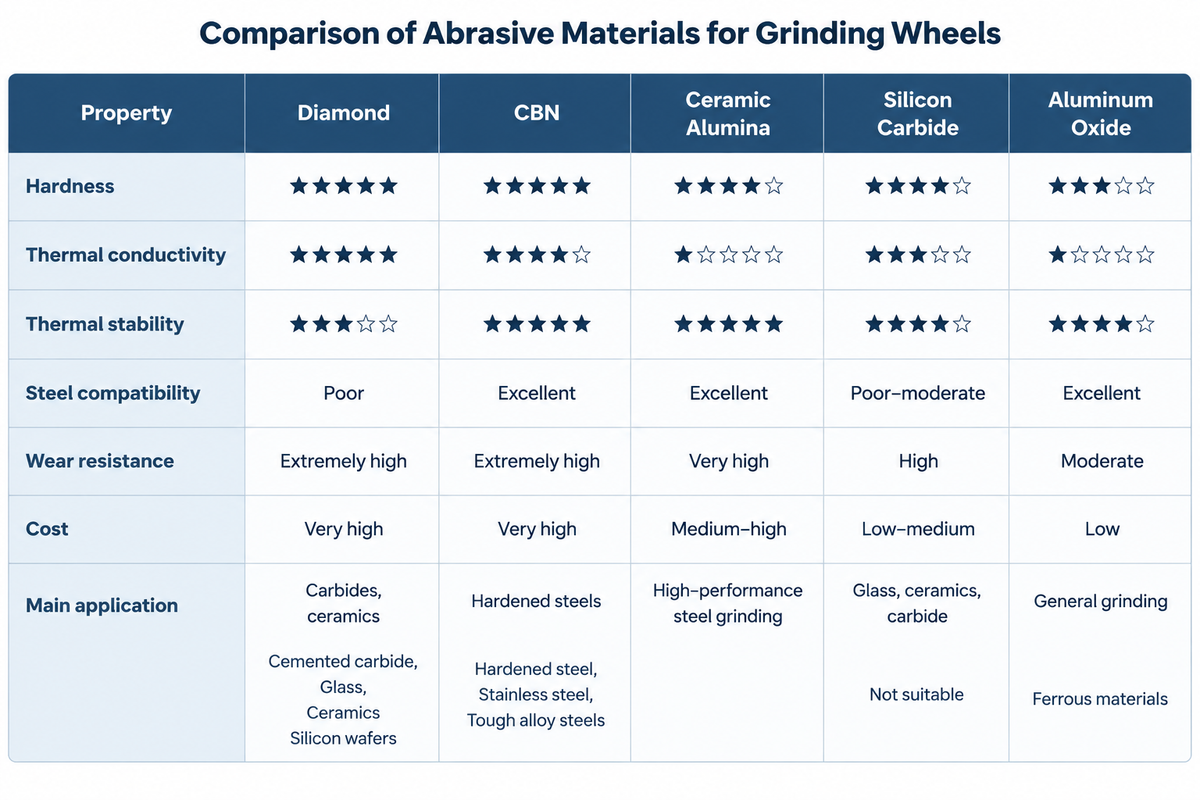
Grinding wheels are essential tools in precision machining and surface finishing processes, designed to remove material from a workpiece through the cutting action of abrasive grains.The performance of a grinding wheel is strongly influenced by the properties of its abrasive material, including hardness, thermal stability, chemical compatibility, and wear resistance. Different abrasive materials offer unique advantages for specific applications, ranging from general-purpose grinding to high-performance machining of hardened steels, ceramics, carbides, and other advanced materials.

Diamond
Diamond, with excellent mechanical properties, ultrahigh hardness, high chemical inertness, low thermal expansion coefficient, and high thermal conductivity, has been widely applied in various fields such as cutting tools, abrasive disks, polishing agents.
| Property | Description |
| Hardness | ~8000–10000 HV (Mohs 10), hardest naturally occurring material known |
| Thermal Conductivity | Very high (~2,200 W/(m·K),) |
| Thermal Stability | Moderate; at elevated temperatures, diamond can transform into graphite, reducing abrasive performance |
| Chemical Stability | Diamond can dissolve into iron and transform into graphite, causing rapid wear. |
| Wear Resistance | Extremely high |
Cubic Boron Nitride (CBN)
Cubic boron nitride (CBN), a synthetic superabrasive with excellent mechanical properties, high hardness, outstanding thermal stability, and superior chemical compatibility with ferrous materials, has been widely applied in precision grinding, cutting tools, and high-performance machining applications.
| Property | Description |
| Hardness | ~4500–5000 HV (Mohs ~9.5), second only to diamond among known abrasive materials |
| Thermal Conductivity | High (~1300 W/(m·K), depending on crystal quality and structure, enabling effective heat dissipation during grinding |
| Thermal Stability | Excellent; CBN can withstand extreme temperatures up to 1,700°C. It maintains abrasive performance at high grinding temperatures and has better thermal resistance than diamond, especially in ferrous material applications |
| Chemical Stability | Excellent with iron-based materials; unlike diamond, CBN does not readily dissolve into iron or undergo graphitization, resulting in low chemical wear |
| Wear Resistance | Extremely high; maintains sharp cutting edges and provides long wheel life under high-speed and precision grinding conditions |

Aluminum oxide (Al₂O₃), also known as alumina, is one of the most widely used conventional abrasive materials due to its excellent toughness, chemical stability, and low cost. It is commonly used for general-purpose grinding of steels and metal alloys, including surface grinding, cylindrical grinding, and tool sharpening.
| Property | Description |
| Hardness | ~1800–2200 HV (Mohs ~9), providing good cutting ability for conventional grinding applications |
| Thermal Conductivity | Low to moderate (~20–40 W/(m·K)), resulting in lower heat dissipation compared with superabrasives such as diamond and CBN |
| Thermal Stability | Good; remains stable at high temperatures and can withstand typical grinding conditions without significant degradation |
| Chemical Stability | Excellent; chemically stable with most metals and suitable for grinding ferrous materials such as carbon steel and alloy steel |
| Wear Resistance | Moderate to high; relatively tough abrasive grains resist fracture and provide good wheel life, although wear is higher than CBN or diamond |
Ceramic Alumina
Ceramic alumina is an advanced form of aluminum oxide abrasive produced through a sol-gel process, creating a microcrystalline structure with controlled fracture behavior. Compared with conventional aluminum oxide, ceramic alumina provides superior cutting efficiency, self-sharpening ability, and longer wheel life. It is widely used for high-performance grinding of steels, stainless steels, aerospace alloys, and difficult-to-machine metals.
| Property | Description |
| Hardness | ~2000–2400 HV (Mohs ~9), similar to conventional alumina but with a finer microcrystalline structure that improves cutting performance |
| Thermal Conductivity | Low to moderate (~20–40 W/(m·K)), lower than SiC, CBN, and diamond; heat management mainly depends on wheel structure and coolant |
| Thermal Stability | Excellent; maintains abrasive integrity at high grinding temperatures due to the high melting point of alumina (~2050°C) and strong ceramic bonding |
| Chemical Stability | Excellent; chemically stable with ferrous metals and suitable for grinding carbon steel, stainless steel, and alloy steels without significant chemical wear |
| Wear Resistance | Very high; micro-fracturing produces continuous self-sharpening, maintaining sharp cutting edges and extending wheel life compared with conventional alumina |
Silicon Carbide (SiC)
Silicon carbide (SiC) is a synthetic abrasive characterized by high hardness, sharp cutting edges, excellent thermal conductivity, and high friability. It is widely used for grinding hard, brittle, and non-ferrous materials such as ceramics, glass, carbide, and stone.
| Property | Description |
| Hardness | ~2500–3000 HV (Mohs ~9–9.5), harder than aluminum oxide and capable of grinding many hard materials |
| Thermal Conductivity | High (~100–200 W/(m·K), depending on crystal structure), allowing improved heat dissipation during grinding |
| Thermal Stability | Excellent; maintains performance at elevated temperatures due to high melting point (~2700°C) and strong covalent bonding |
| Chemical Stability | Good with non-ferrous materials and ceramics; less suitable for steels because SiC can react with iron at high temperatures |
| Wear Resistance | High cutting efficiency but lower wear resistance than CBN and diamond due to its brittle nature and rapid self-sharpening fracture |
Conclusion
